Superpollutant credits: Understanding the market dynamics
August 28, 2026 - Research
Superpollutant credits are gaining attention in the voluntary carbon market. But for companies looking to purchase them, an important question remains: How much supply is actually available, where is it coming from and what does the market look like?
Superpollutant projects represent a meaningful share of available carbon credits and, on average, appear to offer strong greenhouse gas (GHG) integrity relative to several of the largest project categories in the market. At the same time, supply is concentrated in a handful of project types, while newer activities are beginning to emerge.
These dynamics create both opportunities and considerations for buyers.
A sizable pool of credits in a market still dominated by avoidance
The voluntary carbon market continues to be dominated by avoidance credits. As of the second quarter of 2026, REDD and renewable energy represented the two largest pools of available credits, with just over 300 million and just under 300 million credits, respectively.
Superpollutant credits were the third-largest pool, with more than 150 million credits unretired. By comparison, removals accounted for around 27 million credits. That makes superpollutants a significant part of the current market and an important category for buyers seeking volume.
But volume alone does not tell the full story.
The two largest pools of credits, REDD and renewable energy, are credit categories where integrity of existing supply can be a challenge. Superpollutants, by contrast, represent a sizable pool of credits that, on average, can have stronger GHG integrity.
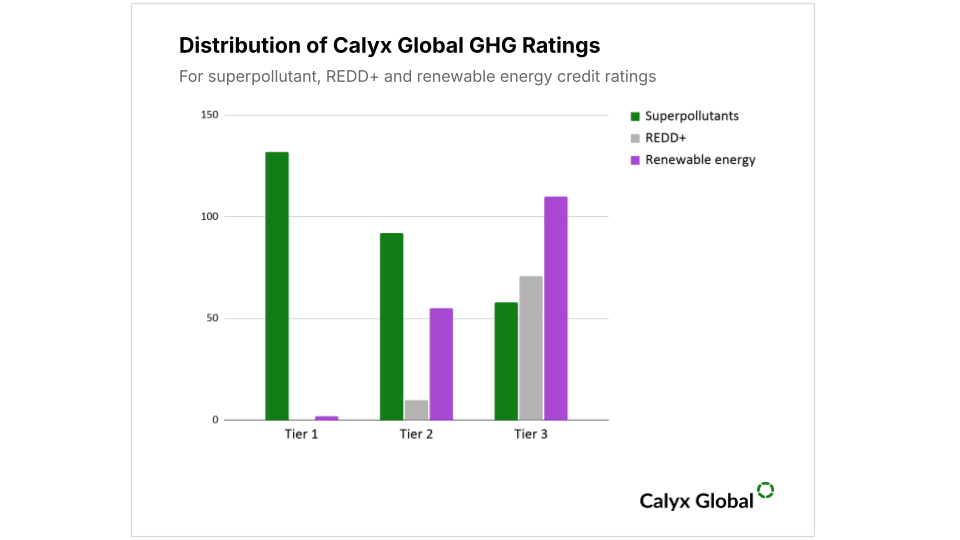
The figure above shows the integrity distribution of superpollutant ratings (green), REDD+ rating (silver) and renewable energy ratings (purple). Ratings in Tier 1 have higher GHG integrity.
Supply is concentrated — but the mix is changing
Looking specifically at credits issued in 2026 provides another view of the market.
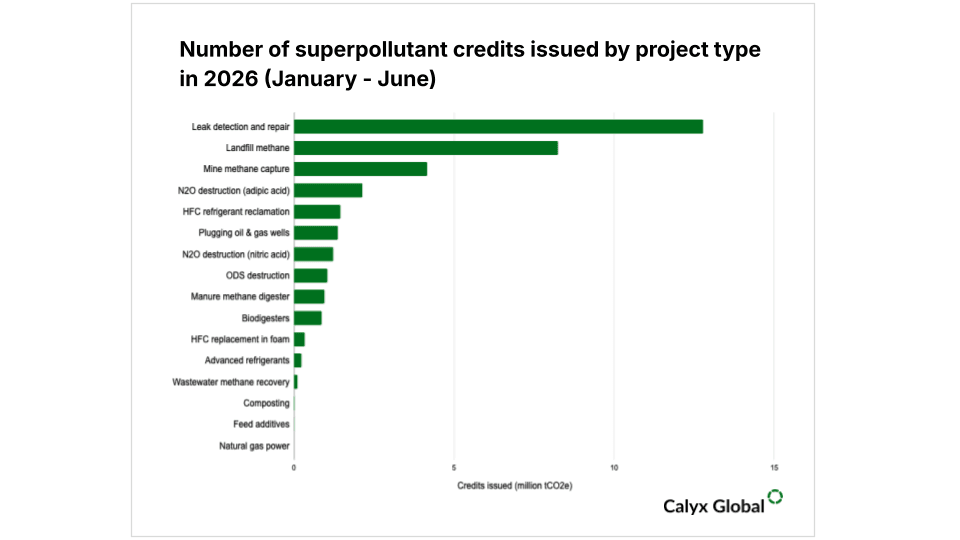
Around 35 million superpollutant credits have been issued in the first half of 2026, with approximately 35% of that supply coming from leak detection and repair (LDAR) projects. LDAR, landfill methane and mine methane capture credits represented the largest share of total superpollutant issuances in 2026; over 70% of credits came from these three project types.
This concentration is important for buyers.
A large overall supply of superpollutant credits does not necessarily mean buyers can find the same volumes across every project type. The pool available to a particular buyer can narrow considerably once preferences around project type, methodology, geography, vintage and credit quality are taken into account.
For buyers, this points to a familiar carbon market lesson: headline supply and usable supply are not necessarily the same thing. For a buyer looking for a specific combination of quality, project type and volume, the pool of suitable credits may be much smaller than the overall supply suggests.
The figure below shows superpollutant credit issuance by project type in the first half of 2026 (Quartson et al, 2026). Issuance was dominated by LDAR, landfill methane, and mine methane capture projects, while activities such as wastewater methane recovery, composting, and feed additives accounted for smaller shares.
Quality is still not well understood
With growing attention on superpollutant credits, there is also a broader shift in the voluntary carbon market toward greater scrutiny of GHG integrity. However, the market is still struggling to price superpollutant quality.
In our joint publication with ClearBlue Markets earlier this year, The state of quality and pricing, we illustrated how there is increasing price discovery in most sectors, except superpollutants. In particular, the market is starting to understand and price in quality for nature-based and cookstove credits, but superpollutants remain misunderstood and potentially undervalued.
Where could future supply come from?
Future supply may look quite different from today's market. Rice methane is one area where the pipeline is beginning to build. Verra's new rice methodology aims to strengthen the approach to quantification and monitoring and was recently approved by the ICVCM. More than 5.5 million forward credits from this project type are listed for sale on SupplyBridge currently.
Other super pollution mitigation activities may also scale over time. Orphaned oil and gas wells represent a potentially significant methane-abatement opportunity as methodologies and measurement approaches are refined, particularly around methane measurement, baseline emissions and crediting periods. Refrigerant management is another area to watch, with new and revised methodologies expanding opportunities for destroying and reclaiming HFCs and transitioning to lower-GWP refrigeration systems.
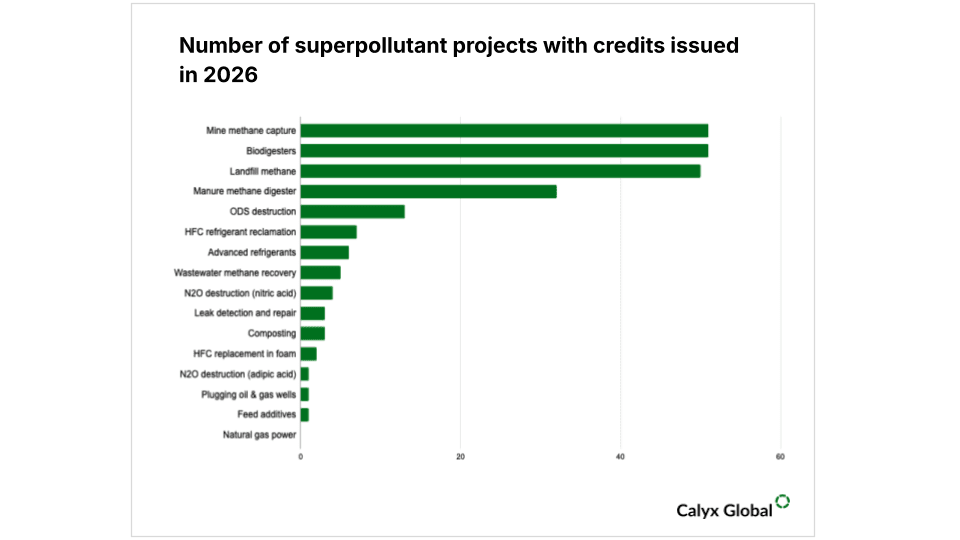
Looking at the number of projects issuing credits in 2026 provides another view of where activity is concentrated. Mine methane capture, biodigesters and landfill methane have the largest number of projects with issued credits, followed by manure methane digesters. ODS destruction, by comparison, is represented by a smaller number of issuing projects. The table below outlines the number of superpollutant projects with issuances in 2026 (Quartson et al, 2026).
What does this mean for buyers?
The superpollutant market can offer a potentially useful combination: meaningful volume, a diverse set of mitigation activities, and relatively strong average GHG integrity compared with some larger segments of the voluntary market.
But buyers should look beyond the headline numbers.
1. Define the quality you need
Start by determining what quality means for your organization. If credits are being used for compensatory purposes, GHG integrity will be particularly important.
Other considerations may include Sustainable Development Goal contributions, environmental and social risks, geography or alignment with particular market standards.
2. Look at project-level supply
A market may have millions of credits available without having enough credits that meet your specific requirements.
Consider the project type, methodology, geography, vintage, rating and availability together. This will give you a more realistic picture of the supply that is actually accessible to your organization.
3. Consider timing
Supply and demand can shift as buyers enter the market, projects issue new credits, and methodologies evolve. If you need a particular volume by a particular date, start the sourcing process early.
As Calyx Global's 6 steps to sourcing high-quality carbon credits notes, buyers can find that credits they expected to purchase are no longer available in the quantity or at the price they anticipated.
4. Build independent project-level due diligence into the process
Validation and verification provide important assurance, but they do not eliminate the need for buyer project-level due diligence.
Independent analysis can help buyers assess whether credits meet their specific quality requirements and identify risks that may not be apparent from project documentation alone. Calyx Global's approach combines deep analysis of project documentation with additional research and expert review to assess project-level GHG integrity.
A market worth watching
Superpollutant credits are no longer a niche corner of the voluntary carbon market. With over 150 million credits available through the second quarter of 2026 and 70 million credits issued in 2025, the category represents a meaningful supply of carbon credits.
At the same time, the market is not static. Supply remains concentrated in particular project types, while activities such as oil and gas well plugging are developing. Methodology approvals and growing buyer attention to GHG integrity are also shaping how the market evolves.
For carbon credit buyers, the opportunity is not simply to find volume. It is to identify the right volume: credits that meet their quality requirements, are available when needed and fit the broader goals of their climate strategy.
Superpollutant credits may have an increasingly important role to play — but as with any carbon credit purchase, the quality of the individual credits matters as much as the size of the pool.
Citations:
Pamela Quartson, Barbara K Haya, Tyler Bernard, Aline Abayo, Xinyun Rong, Ivy S So, Micah Elias. (2026). Voluntary Registry Offsets Database v2026-06, Berkeley Carbon Trading Project, University of California, Berkeley. Retrieved from: https://gspp.berkeley.edu/berkeley-carbon-trading-project/offsets-database
Keep up with carbon market trends
Get the monthly newsletter and stay in the loop.
Trusted By






Next Up