VM0048 after two years: First credits on the horizon
April 14, 2026 - Commentary
Two and a half years after Verra released VM0048, its overhauled methodology for Avoiding Unplanned Deforestation (AUD) REDD projects, the first credits are on the verge of being issued under the new framework. This is the moment the market has been waiting for.
Below is where things stand: what changed structurally, what remains imperfect, what the transition pipeline looks like and what buyers and project developers should expect.
How we got here
In 2023, investigative journalism and peer-reviewed research converged on the same finding: REDD projects had been significantly overcrediting. Calyx Global's own analysis, published that year, showed that the vast majority of projects claimed far more emissions reductions than independently estimated baselines would justify—most sitting well above a one-to-one line between what they claimed and what our analysis supported.
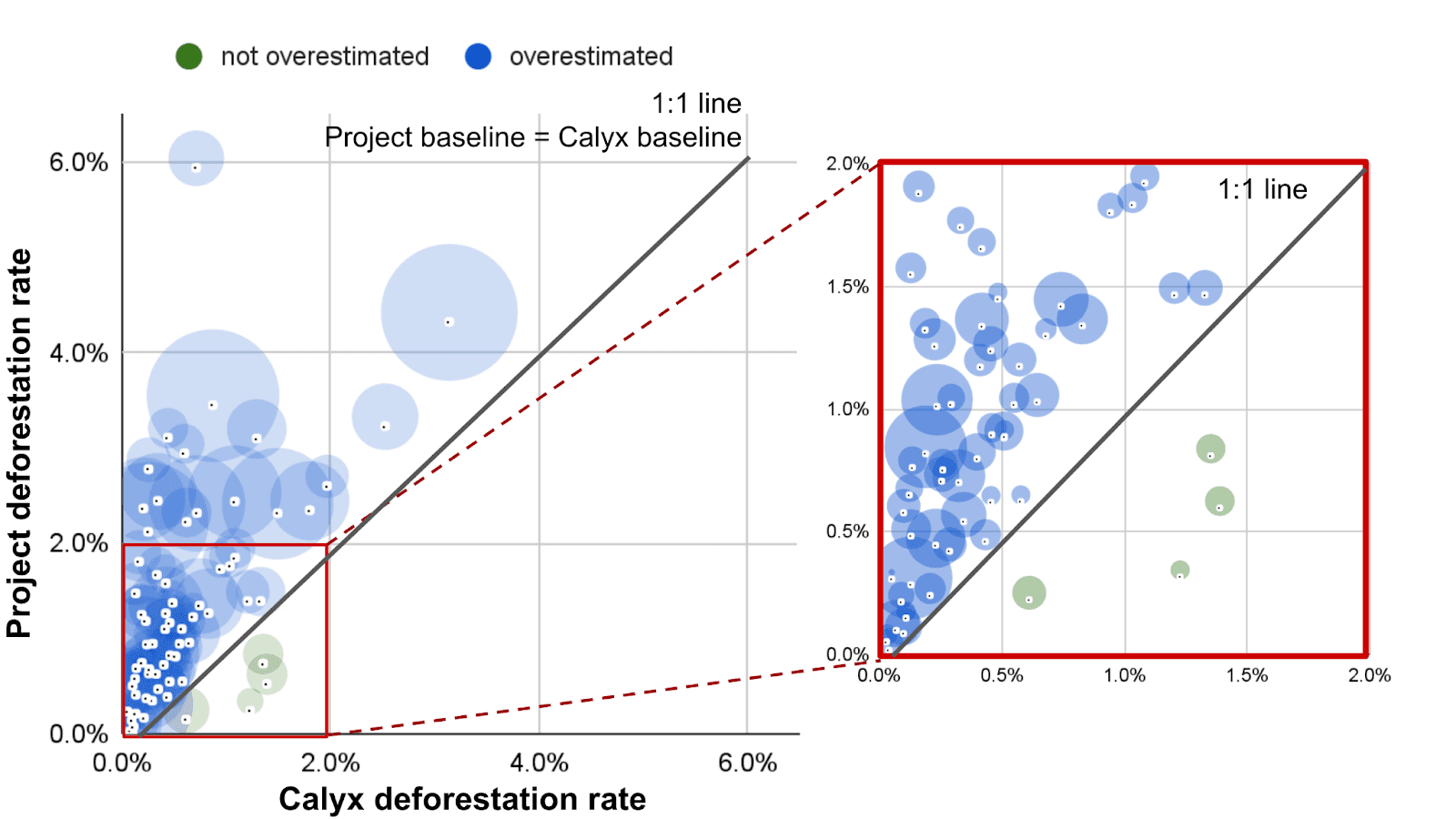 Turning REDD into Green, Calyx Global April 2023
VM0048 was Verra's response, released in November 2023. It introduced an entirely new approach to baseline-setting for AUD projects.
What changed
The most consequential innovation in VM0048 is that Verra now works with a third party to produce project baselines. Verra’s independent data providers produce deforestation risk maps for entire jurisdictions and allocate expected deforestation across the entire jurisdiction, assigning a share to each project. There is, in effect, one pie and all projects in a jurisdiction get their “fair slice”. This cap and third-party allocation mitigate the baseline inflation that was endemic when each developer set their own reference level independently.
These maps deserve specific attention, as they consider a number of factors beyond proximity to past deforestation. The risk models approved by Verra incorporate many of the same variables used in Calyx Global's own methodology, including distance to roads, rivers, and population centers, as well as historical deforestation patterns. Preliminary analysis shows that the resulting maps align closely with Calyx Global's independent assessments—a meaningful convergence that speaks to methodological rigor.
Additionally, baselines are now valid for six years rather than ten, shortening the window over which any error can compound before it is revisited.
What remains imperfect
Several sources of potential overcrediting persist.
Baselines are constructed using historical averages over a ten-year reference period. If deforestation has been declining in a given area—as it has in parts of the Amazon—averaging across a decade will overstate expected future deforestation. Verra's working assumption is that few jurisdictions currently show meaningful downward trends; this assumption should be revisited over time.
Emission factors (the carbon stock values associated with forests) are still selected by the project developer. Where a developer consistently selects high values, overcrediting remains possible even where the deforestation risk map is sound. Project-level monitoring of actual deforestation during the crediting period is also still the project's responsibility, a setup that Calyx has previously identified as a source of bias.
Deforestation risk maps often focus only on land cover, which does not tell the full story. We also believe it is critically important to assess the land use. Is the historic data used to predict future deforestation from a similar type of land as the project? The risk maps assume that all forests are subject to the same basic risks, but some types of land use have a lower likelihood of deforestation, even if they occur on the edge of a deforestation frontier. A well-protected state reserve would be one example, or a longstanding, privately held forest with secure tenure.
Finally, model uncertainty in the deforestation risk maps is not fully propagated into credit calculations. The methodology improves on its predecessors, but uncertainty accounting remains incomplete.
The transition pipeline
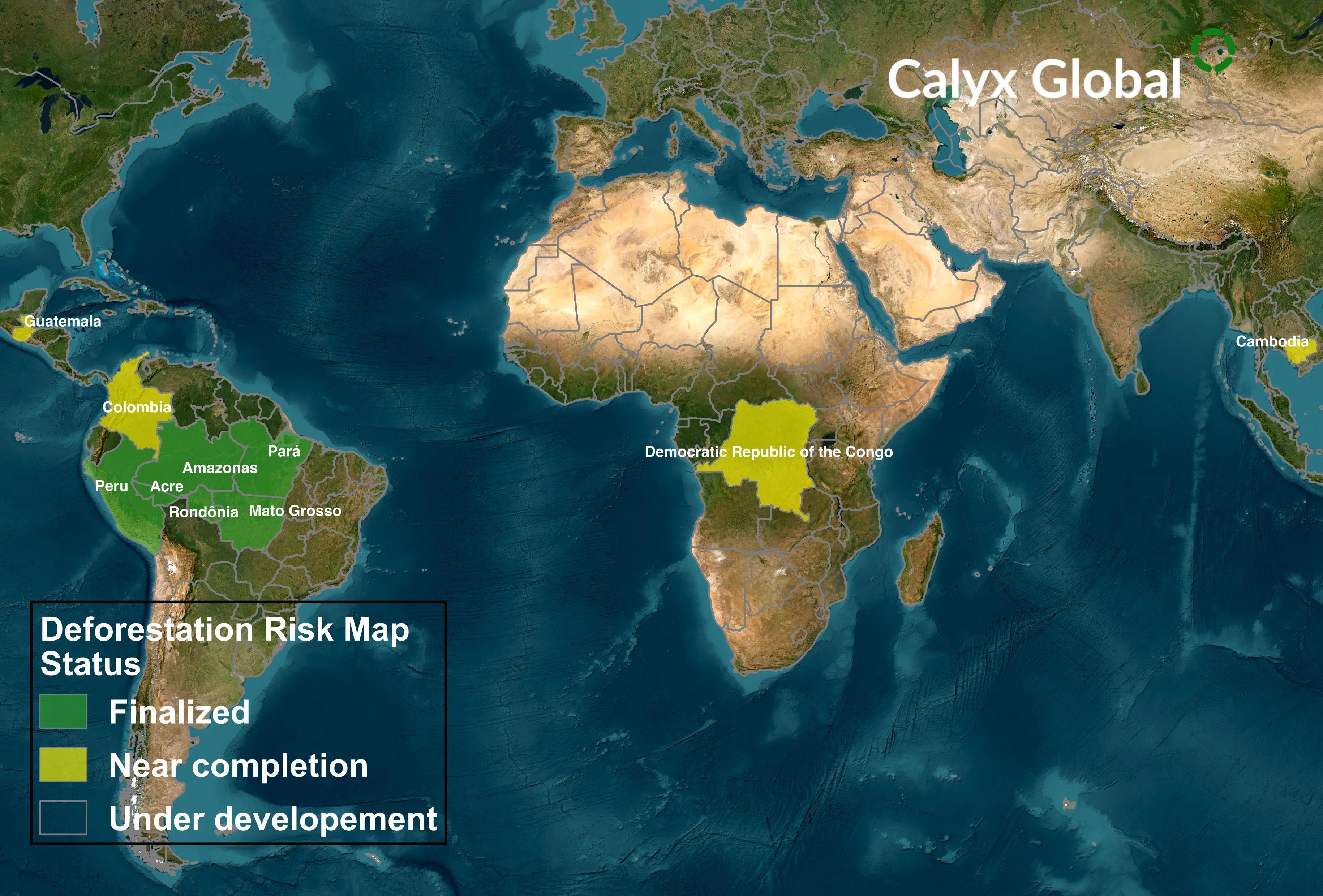
All 97 existing AUD projects must transition to VM0048 at their next verification, once their jurisdiction's deforestation risk maps have been available for six months. Finalized maps currently exist for six jurisdictions: Peru (nationally) and five Brazilian states: Mato Grosso, Pará, Amazonas, Rondônia and Acre. Four further jurisdictions, Cambodia, Colombia, DRC (Mai Ndombe) and Guatemala, are near completion.
The first tranche due to transition covers Pará and Mato Grosso, where maps have been available for more than six months. Six projects should be verifying now, with one verification already pending. Thirteen projects in Peru are due by June and five have pending verifications. Next, ten projects in Amazonas, Acre and Rondônia will come due in July; four verifications are already pending. Calyx Global has existing ratings under legacy methodologies for the majority of projects across all three tranches. We look forward to comparing them.
One finding warrants particular attention. A number of projects moved to request verification approval early enough to avoid the new maps for this round of verification. Under the transition rules, a project that submits its verification request before the six-month window closes is not obligated to adopt VM0048 in this cycle. Some projects were unable, or declined, to wait until the maps were released. The initial wave of VM0048 transitions will therefore be smaller than pipeline numbers suggest—of the five Peru projects seeking verification, only three will use the new maps. Of the four in Amazonas, Acre or Rondônia, none are likely to actually use the new maps.
In addition to the 97 existing AUD projects, 25 new projects are listed under VM0048. Three are under validation in jurisdictions with finalized maps and one has already requested verification. Two more projects are under validation but are awaiting final maps.
What to expect: fewer credits, better quality
Calyx's preliminary analysis of 15 established REDD projects in Brazil, assessed against Verra's new deforestation risk maps, points to a significant reduction in credit volumes. On average, these projects could issue approximately 40 percent fewer credits under VM0048 than under their legacy baselines. Almost half could see reductions of 50 percent or more; some may see issuance fall by 90 percent or more. A small number of projects could see modest increases in volume.
The quality picture is more encouraging. We see a credible pathway to BBB (or above)-rated REDD credits, a level we have not previously been able to ascribe to this project type. The key driver is baseline risk: the single most impactful integrity improvement possible. Third-party derived deforestation maps substantially narrow the gap between project claims and independently estimated baselines.
Getting above BBB would require further risk reduction elsewhere. Longer monitoring commitments— beyond the standard 40-year project duration—could reduce non-permanence risk. Conservative emission factor selection and adequately capturing project emissions could close the remaining gap; both are under the control of the project developer.
CORSIA eligibility
Are VM0048 credits eligible under CORSIA, the aviation sector's carbon offsetting scheme?
Currently, the answer is no for “REDD countries” (which are not clearly defined by CORSIA, but include many developing countries). The International Civil Aviation Organization (ICAO)'s October 2025 list of CORSIA-eligible emissions units includes some nature-based methodologies, but REDD credits are currently only eligible from jurisdictional REDD (J-REDD) programs. To date, CORSIA has excluded most forest-related project-scale methodologies in developing countries. That said, individual VM0048 projects could be nested into a J-REDD program if the government opted to do so. Because VM0048 uses “one pie” determined at the jurisdictional level, it may be easier to nest such projects into a J-REDD scheme.
Other REDD+ methodologies to watch
VM0048 is not the only evolving REDD methodology worth following.
Cercarbono, the Colombian carbon standard, operates its own REDD+ methodology (M/LU-REDD+), with over 40 listed projects concentrated in Colombia and Brazil. Equitable Earth's M002 Terrestrial Forest Conservation methodology is currently operational in seven Brazilian states and five countries, but no projects have been listed so far. Stay tuned for updates on key integrity risks in all the latest REDD methodologies.
What Calyx is watching for
The next few months will be telling. When the first VM0048 verifications land, we will be looking at three things specifically: how closely each project's monitoring of actual deforestation aligns with what independent satellite data shows for the same area; how emission factors are selected across projects in the same ecosystem; and whether the use of the risk map is appropriate for the project context.
We will publish ratings and commentary as projects come through. Questions in the interim, or interest in a specific project, can be directed to info@calyxglobal.com.
Dr. Deborah Lawrence, Chief Scientist, Calyx Global
Keep up with carbon market trends
Get the monthly newsletter and stay in the loop.
Trusted By