The good and bad: Read our 2026 State of the Voluntary Carbon Market report.

Read the report

ICVCM CCP-label tracker

February 5, 2026 - Commentary

The Core Carbon Principles (CCPs) were developed by the Integrity Council for the Voluntary Carbon Market (ICVCM) to set a minimum benchmark for carbon credit quality. These principles were designed to help market participants identify carbon credits that meet certain criteria to promote environmental impact and alignment with climate goals.

In early 2024, the ICVCM began assessing various “categories” of carbon credits for CCP labeling. A category is a project type combined with a carbon methodology. The ICVCM decides whether each category is eligible to receive the CCP label. 

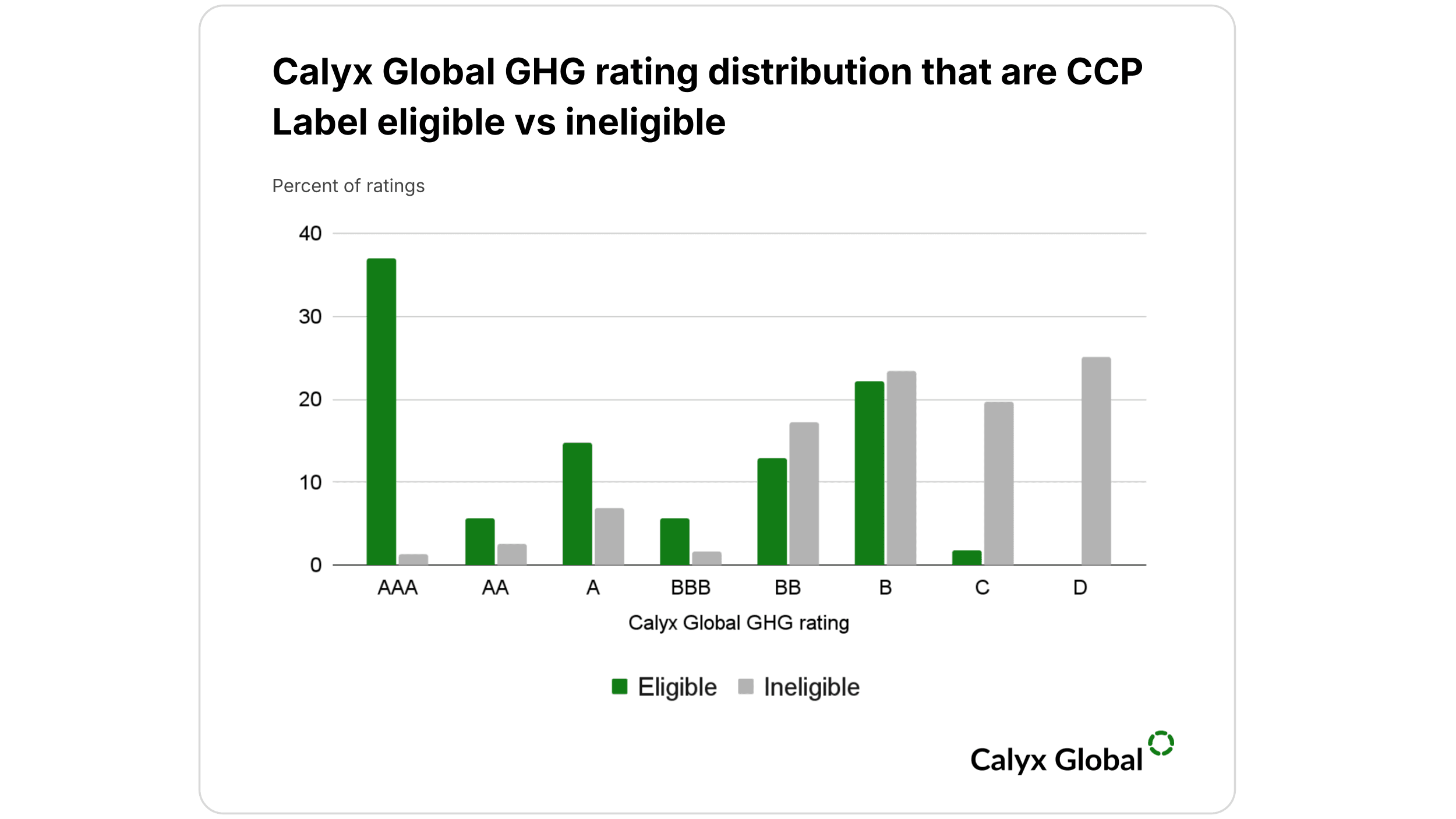
Calyx Global provides independent, project-level assessments of greenhouse gas (GHG) integrity risk in carbon projects. Our approach is aligned with the core carbon principles. Below is a distribution of GHG ratings for projects that are CCP label eligible alongside those that will not receive the CCP label. Importantly, this chart only represents projects Calyx Global has assessed and may be missing projects that have yet to be rated or issue credits.
CCP charts_nov 2025.png

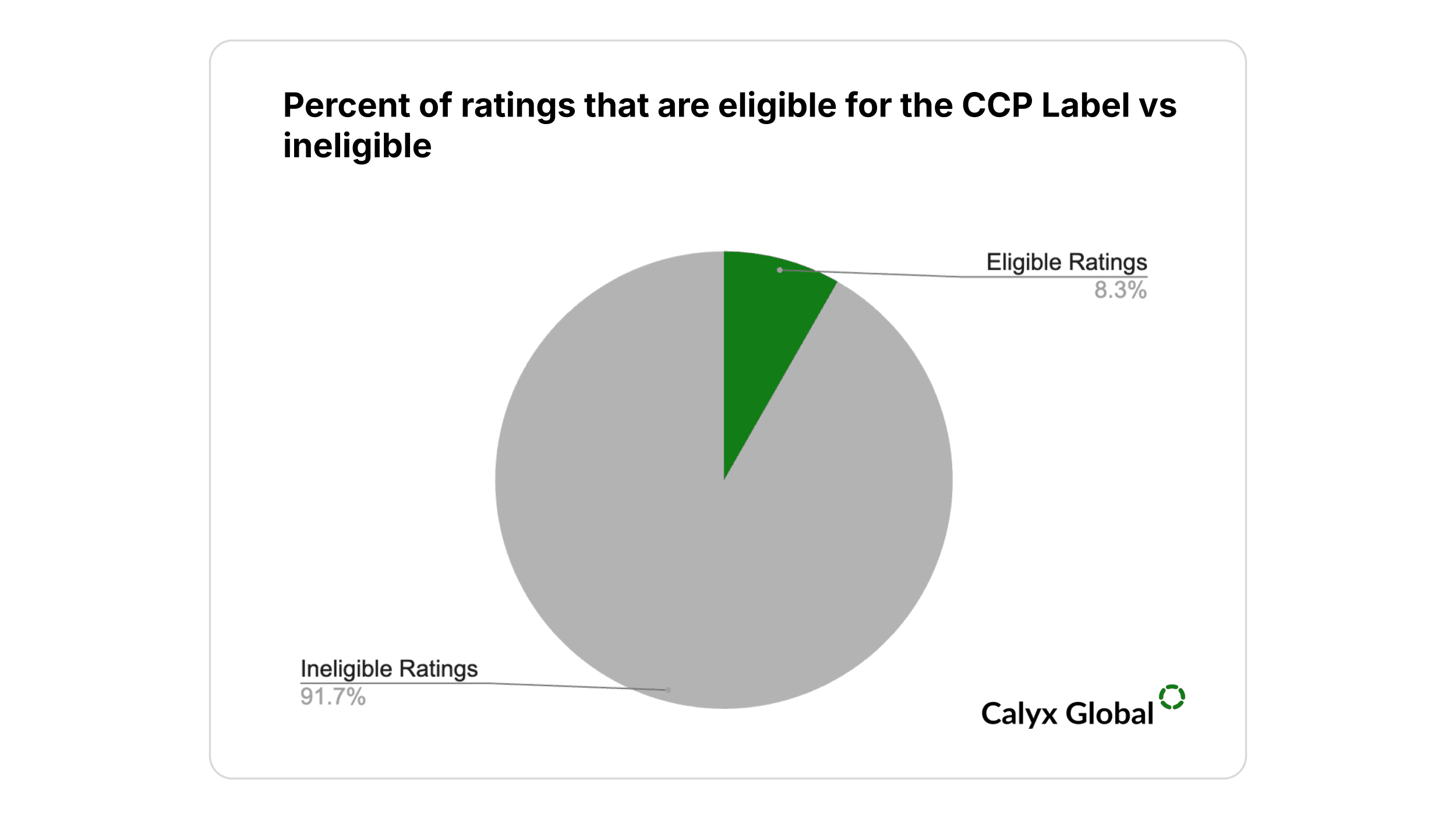
The number of ratings eligible for the CCP label vs ineligible remains a small percentage of the Calyx Global GHG ratings. As of November 20, 2025, only around 8% of the projects Calyx Global has rated are currently eligible for the CCP label.
CCP charts_nov 2025 (1).png

** “CCP label” represents projects Calyx Global has rated that are in an approved category (i.e., project type + methodology). “No CCP label” includes categories that have been rejected by the ICVCM Board and/or where a carbon crediting program has itself excluded a category from consideration (e.g., VCS has excluded old REDD methodologies and a cookstove methodology).

To learn how CCP labeling works, see our explainer here. Otherwise, we built this tracker to give market participants up-to-date access to ICVCM CCP label decisions alongside our expert analysis. 

The ICVCM CCP label tracker

Category-level assessments*

Last updated: February 5, 2026

Project categoryMethodologies ProgramsStatusNotes and links to Calyx Global analysis
Afforestation, reforestation and revegetation
  • ACR Afforestation and Reforestation of Degraded Lands, v 1.0-1.2
  • Isometric Reforestation Protocol, v 1.1
  • VCS – VM0047 Afforestation, Reforestation, and Revegetation, v 1.0-1.1
ApprovedN/A
  • CAR Mexico Forest Protocol - ARR, v 2.0-3.0
  • GS Afforestation/Reforestation (A/R) GHG Emissions Reduction & Sequestration Methodology, v 2.1
  • GS Sustainable Management of Mangroves, v 1.0
  • Isometric Agroforestry, v 1.0
  • Isometric Mangrove Restoration, v 1.0
  • Equitable Earth – M001 Quantification Methodology for Terrestrial Forest Restoration, v 1.2
Assessment in progressAwaiting announcement
Biochar
  • CAR U.S. and Canada Biochar, v 1.0
  • Isometric – Biochar Production and Storage, v 1.0
  • VCS – VM0044 Methodology for Biochar Utilization in Soil and Non-Soil Applications, v 1.2
ApprovedN/A
  • Isometric – Biochar Production and Storage, v 1.1-1.2
  • Puro.earth – Biochar Methodology 2022, v 3.0
  • Puro.earth – Biochar Methodology 2025, v 2.0
Assessment in progressAwaiting announcement
Biodigesters (household)
  • GS Methodology for Animal Manure Management and Biogas Use for Thermal Energy Generation v 1.0-1.1
Approved with additional requirementsCalyx Global analysis
  • GS, VCS – AMS-I.E. - Switch from non-renewable biomass for thermal applications by the user, v 1.0-13.0
  • Gold Standard – AMS-I.I. – Biogas/biomass thermal applications for households/small users, v 1.0-6.0
RejectedCalyx Global analysis
eCDR
  • GS Carbon Sequestration Through Accelerated Carbonation Of Concrete Aggregate, v 1.0

Approved with additional requirements


An introduction to CO2-injected concrete 


Calyx Global analysis on carbon sequestration


An introduction to direct air capture


Report on embodied emissions accounting in eCDR

  • Isometric – Bio-oil Geological Storage, v 1.0-1.1
  • Isometric – Biogenic Carbon Capture and Storage​, v 1.1
  • Isometric – Biomass Geological Storage, v 1.0-1.1
  • Isometric – Direct Air Capture, v 1.1
  • Isometric – Subsurface Biomass Carbon Removal and Storage​, v 1.0
Approved
  • GS Carbon mineralisation using reactive mineral waste, v 2.0
  • GS Methodology for Biomass Fermentation with Carbon Capture and Geologic Storage, v 2.0
  • Puro.earth – Carbonated Materials 2022, v 3.0
  • Puro.earth – Geologically Stored Carbon 2024, v 1.0
  • Puro.earth – Terrestrial Storage of Biomass 2023, v 1.0
  • Verra (VCS) – VM0049 Carbon Capture and Storage, v 1.0
Assessment in progressAwaiting announcement
Efficient cookstoves
  • GS Methodology for Metered & Measured Energy Cooking Devices v 1.0-1.2
  • GS Technologies and Practices to Displace Decentralized Thermal Energy Consumption (TPDDTEC) v 2.0-3.1, v 4.0
  • VCS – VM0050 Energy Efficiency and Fuel-Switch Measures in Cookstoves v 1.0
Approved with additional requirements

Calyx Global analysis 


Calyx Global analysis for TPDDTEC, v 2-3.1

  • GS Emission Reductions from Safe Drinking Water Supply, v 1.0
Assessment in progressAwaiting announcement
  • Gold Standard – AMS-II.G. - Energy efficiency measures in thermal applications of non-renewable biomass v 1.0-13.1
  • GS The Gold Standard Simplified Methodology for Clean and Efficient Cookstoves v 1.0-3.0
RejectedCalyx Global analysis
Enhanced weathering
  • Isometric – Enhanced Weathering in Agriculture, v 1.0-1.1
  • Puro.earth – Enhanced Rock Weathering Methodology 2025, v 1.0
Assessment in progressAwaiting announcement
Enteric methane
  • VCS – VM0041 Methodology for the Reduction of Enteric Methane Emissions from Ruminants through the Use of Feed Ingredients, v 2.0
Assessment in progressAwaiting announcement
HFC Displacement
  • ACR Certified Reclaimed HFC Refrigerants, Propellants, and Fire Suppressants, v 1.0-2.0
Assessment in progressAwaiting announcement
HFC Replacement
  • ACR Advanced Refrigeration Systems, v 1.0-3.0
  • ACR Transition to Advanced Formulation Blowing Agents in Foam Manufacturing and Use, v 1.0-3.0
Assessment in progressAwaiting announcement
HFC-23 destruction: HFC-23 abatement from HCFC-22 production
  • VCS – AM0001 – Decomposition of fluoroform (HFC-23) waste streams, v 1.0-5.0
Very unlikely to meetAwaiting announcement
Improved forest management
  • ACR Improved Forest Management (IFM) on Non-Federal U.S. Forestlands, v 2.0
  • ACR Improved Forest Management (IFM) on Non-Federal U.S. Forestlands, v 2.1
  • CAR Mexico Forest Protocol, v 3.0
  • VCS – VM0045 Improved Forest Management Methodology Using Dynamic Matched Baselines from National Forest Inventories, v 1.2
  • VCS – VM0045 Improved Forest Management Methodology Using Dynamic Matched Baselines from National Forest Inventories
Approved with additional requirementsN/A
  • ACR Improved Forest Management (IFM) on Canadian Forestlands, v 1.0
  • ACR Improved Forest Management (IFM) on Non-Federa U.S. Forestlands, v 1.3
  • ACR Improved Forest Management (IFM) on Small Non-Industrial Private Forestlands, v 1.0
  • CAR Mexico Forest Protocol, v 2.0
  • Isometric Improved Forest Management, v 1.0
Assessment in progressAwaiting announcement
Industrial biodigesters
  • CAR Argentina Livestock, v 1.0
  • CAR Dominican Republic Livestock, v 1.0
  • CAR Mexico Livestock Protocol, v 2.0
  • CAR U.S. Livestock Protocol, v 1.0-4.0
Assessment in progressAwaiting announcement
Industrial energy efficiency (supply side)
  • VCS – AM0017 – Steam system efficiency improvements by replacing steam traps and returning condensate, v 1.0-2.0
  • VCS – AM0018 – Baseline methodology for steam optimization systems, v 1.0-4.0
  • VCS – AM0020 – Baseline methodology for water pumping efficiency improvements v 1.0-2.0
Very unikely to meetAwaiting announcement
Just transition
  • VCA – VM0052 – Accelerated Retirement of Coal-Fired Power Plants Using a Just Transition, v 1.0
Assessment in progressAwaiting announcement
Landfill avoidance
  • CAR U.S. Organic Waste Composting Protocol, v 1.0-1.1
  • GS Methodology for Collection of Macroalgae to Avoid Emissions from Decomposition, v 1.0
Assessment in progressAwaiting announcement
Landfill gas
  • ACR Landfill Gas Destruction and Beneficial Use Projects, v 1.0-2.0
  • CAR U.S. Landfill Protocol v 6.0
Approved

Calyx Global analysis 1

Calyx Global analysis 2

  • GS, VCS – ACM0001 – Flaring or use of landfill gas, v 15.0-19.0
  • GS, VCS – AMS-III.G. – Landfill methane recovery, v 9.0-10.0
Approved with additional requirements
  • CAR Mexico Landfill Protocol, v 2.0
  • CAR U.S. Landfill Protocol, v 5.0
  • CAR U.S. Landfill Protocol, v 6.0
Assessment in progressAwaiting announcement
LDAR
  • VCS – AM0023 – Leak detection and repair in gas production, processing, transmission, storage and distribution systems and in refinery facilities, v 4.0
ApprovedN/A
Marine carbon dioxide removals
  • Isometric – Ocean Alkalinity Enhancement from Coastal Outfalls, v 1.0
  • Puro.earth – Direct Air Capture and Ocean Storage 2025, v 1.0
  • Puro.earth – Marine Anoxic Carbon Storage 2025, v 1.0
  • Puro.earth – Microalgae Carbon Fixation and Sinking 2025, v 1.0
Assessment in progressAwaiting announcement
Mine methane
  • ACR Capturing and Destroying Methane from Coal and Trona Mines in North America, v 1.0-1.1
  • VCS – ACM0008 - Abatement of methane from coal mines, v 6.0-8.0
Assessment in progressAwaiting announcement
N2O abatement in adipic acid production
  • CAR U.S. Adipic Acid Production Protocol, v 1.0
  • CAR China Adipic Acid Production Protocol, v 1.0
ApprovedCalyx Global analysis
N2O abatement in nitric acid production
  • CAR U.S. Nitric Acid Production Protocol, v 3.0
Assessment in progressAwaiting announcement
  • VCS – AM0028 – N2O destruction in the tail gas of Caprolactam production plants, v 1.0-6.0
  • VCS – AM0034 – Catalytic reduction of N2O inside the ammonia burner of nitric acid plants, v 1.0-5.1.1
Very unlikely to meet
New natural gas power
  • VCS – ACM0025 – Construction of a new natural gas power plant, v 1.0-2.0
  • VCS – AM0107 – New natural gas based cogeneration plant, v 1.0-4.0
Very unlikely to meetAwaiting announcement
Ozone-depleting substances destruction
  • ACR – Destruction of Ozone Depleting Substances (ODS) from International Sources – v 1.0
  • CAR – Article 5 Ozone Depleting Substances Protocol v 1.0-2.0
  • CAR – U.S. Ozone Depleting Substances Protocol v 1.0-2.0.
Approved

Calyx Global analysis


Note: ACR’s U.S. ODS methodologies still under review

  • ACR Destruction of Ozone Depleting Substances (ODS) and High-Global Warming Potential (GWP) Foam, v 1.0-2.0
Assessment in progressAwaiting announcement

REDD+

(Jurisdictional)

  • ART The REDD+ Environmental Excellence Standard (TREES) v 2.0 – (non-HFLD, removals)
  • VCS Jurisdictional and Nested REDD+ (JNR) Framework, v 4.1
Approved with additional requirementsN/A
  • ART The REDD+ Environmental Excellence Standard (TREES), v2.0 – HFLD Crediting Approach
  • ART The REDD+ Environmental Excellence Standard (TREES), 2.0 – Removals Crediting Approach
Scheduled for considerationAwaiting announcement
REDD+ (Project)
  • VCS – VM0048 Reducing Emissions from Deforestation and Forest Degradation, v 1.0
Approved with additional requirementsCalyx Global analysis
  • ACR Active Conservation and Sustainable Management on U.S. Forestlands v1.0
Scheduled for considerationAwaiting announcement
Renewable energy (grid connected)
  • GS, VCS – ACM0002 – Grid-connected electricity generation from renewable sources, v 1.0-21.0
  • GS, VCS – ACM0006 – Electricity and heat generation from biomass, v 1.0-16.0
  • GS, VCS – ACM0018 – Electricity generation from biomass in power-only plants, v 1.0-6.0
  • GS, VCS – AMS-I.D. – Grid connected renewable electricity generation, v 1.0-18.0
RejectedCalyx Global analysis
Renewable energy (mini-grids
  • GS, VCS – AMS-I.L. – Electrification of rural communities using renewable energy, v 1.0-4.0
RejectedN/A
Renewable energy (off-grid)
  • GS, VCS – AMS-I.A. - Electricity generation by the user, v 1.0-19.0
RejectedN/A
Renewable energy (thermal)
  • GS, VCS – AM0036 – Use of biomass in heat generation equipment, v 1.0-7.0
  • GS, VCS – AM0072 – Fossil Fuel Displacement by Geothermal Resources for Space Heating, v 1.0-3.0
RejectedN/A
Rice cultivation methane avoidance
  • GS Methodology for Methane Emission Reduction by Adjusted Water Management Practice in Rice Cultivation, v 1.0
Approved with additional requirementsN/A
  • VCS – VM0051 Improved Management in Rice Production Systems, v 1.0
Assessment in progressAwaiting announcement
SF6 Avoidance
  • VCS – AM0065 – Replacement of SF6 with alternate cover gas in the magnesium industry, v 2.1
RejectedNote: There are very few SF6 projects
Sustainable agriculture
  • CAR U.S. Soil Enrichment Protocol, v 1.1
  • VCS – VM0042 Methodology for Improved Agricultural Land Management, v 2.2
Approved with additional requirementsN/A
  • GS Soil Organic Carbon Framework Methodology, v 1.0
Assessment in progressAwaiting announcement
Waste heat recovery
  • VCS – ACM0012 – Waste energy recovery, v 1.0-6.0
  • VCS – AMS-III.Q. – Waste energy recovery, v 1.0-6.0
  • VCS – AM0066 – GHG emission reductions through waste heat utilization for pre-heating of raw materials in sponge iron manufacturing process, v 1.0
Very unlikely to meetAwaiting announcement

*This list excludes project categories the ICVCM has yet to commence assessing or has not updated on its public website.

Carbon credits generated by approved cookstove and household biodigester methodologies are eligible for the CCP label only if the following conditions are met:

  • The fraction of non-renewable biomass (“fNRB”) must be derived using the modeling fuelwood savings scenario (MoFuSS) model OR the Clean Development Mechanism default of 0.3 may be applied for a limited period** AND
  • Fuel consumption must be determined either by using a Kitchen Performance Test (KPT) or Controlled Cooking Test (CCT) OR using methodology default values with cross checks on fuel savings, AND
  • For projects that use charcoal, a direct charcoal emission factor (which may include production emissions) or a wood-to-charcoal conversion factor of four to one is used.

Program-level assessments

  Calyx Global screening
Carbon crediting programICVCM statusPass/FailLevel
ACR (American Carbon Registry)Approved

Premium subscriber content


Available for subscribers: independent program-level screenings beyond ICVCM approvals.
 

Click here to access the subscriber portal or contact the team for a demo. 

Architecture for REDD+ (ART)Approved
Climate Action Reserve (CAR)Approved
Ecosystem Restoration Standard (ERS) Approved
Gold Standard (GS)Approved
IsometricApproved
Verified Carbon Standard (VCS)Approved
CercarbanoUnder review
Global Carbon CouncilUnder review
Plano Vivo FoundationUnder review
Puro.earthUnder review
RiverseUnder review
Social CarbonApplication withdrawn, application to be considered in next application cycle 
Wilder CarbonUnder review


Keep up with carbon market trends

Get the monthly newsletter and stay in the loop.

Trusted By

Duke UniversityBanco SantanderCloverlyCargillMetaJP Morgan

About the author

Calyx Global Research Team